Golf Grip Size Chart: How to Choose the Right Grip Size
Grip size is the cheapest fitting decision in golf — and one of the easiest to get wrong. Here's how to measure your hand, read the chart, and pick a size you'll actually want to play.
To use a golf grip size chart, lay your lead hand flat (palm up, fingers together) and measure from the wrist crease to the tip of your middle finger. Under 5" points to junior, 5.0–6.5" to undersize, 6.6–7.5" to standard, 7.6–9.0" to midsize, and 9"+ to jumbo. That's your starting point — but your glove size, swing tendencies, and how the club actually feels in hand all matter, so treat the chart as a first guess, not a verdict.
Jump to a section
| The call | The pick | |
|---|---|---|
| Best Overall Baseline | Golf Pride Tour Velvet (incl. Tour Velvet 360) | AMAZON → |
| Best Between Sizes | Golf Pride MCC Plus4 | AMAZON → |
| Best for Traction | Lamkin Crossline (and Crossline Cord) | AMAZON → |
| Best for Comfort | Winn Dri-Tac | AMAZON → |
+ 2 more picks in the full shortlist ↓
A golf grip size chart is the fastest way to turn a vague feeling — "this club feels a little thin," or "my hands get awfully busy" — into an actual answer. The right grip diameter lets you hold the club securely without strangling it, and the wrong one quietly works against you on every swing. The good news is that finding your size takes one ruler, sixty seconds, and the simple chart below. The honest news is that hand length is where you start, not where you finish.
This guide walks through exactly how to measure golf grip size at home, gives you a clean chart by hand length, explains what "standard," "midsize," and "jumbo" actually mean in inches, and covers the parts most charts skip: the glove-size cross-check, the tape build-up trick, and how grip size nudges your ball flight. Let's get you fitted.
The ToolGrip size calculator
Measure your upper grip hand from the crease of your wrist to the tip of your middle finger, then enter it below. If you have not got a tape measure handy, your glove size gets you most of the way there.
Enter a hand length or pick a glove size.
Mapping as published by Golf Pride, the largest grip manufacturer, checked August 2026. It is their scale, not an industry standard — see below for why the same size name differs between brands.
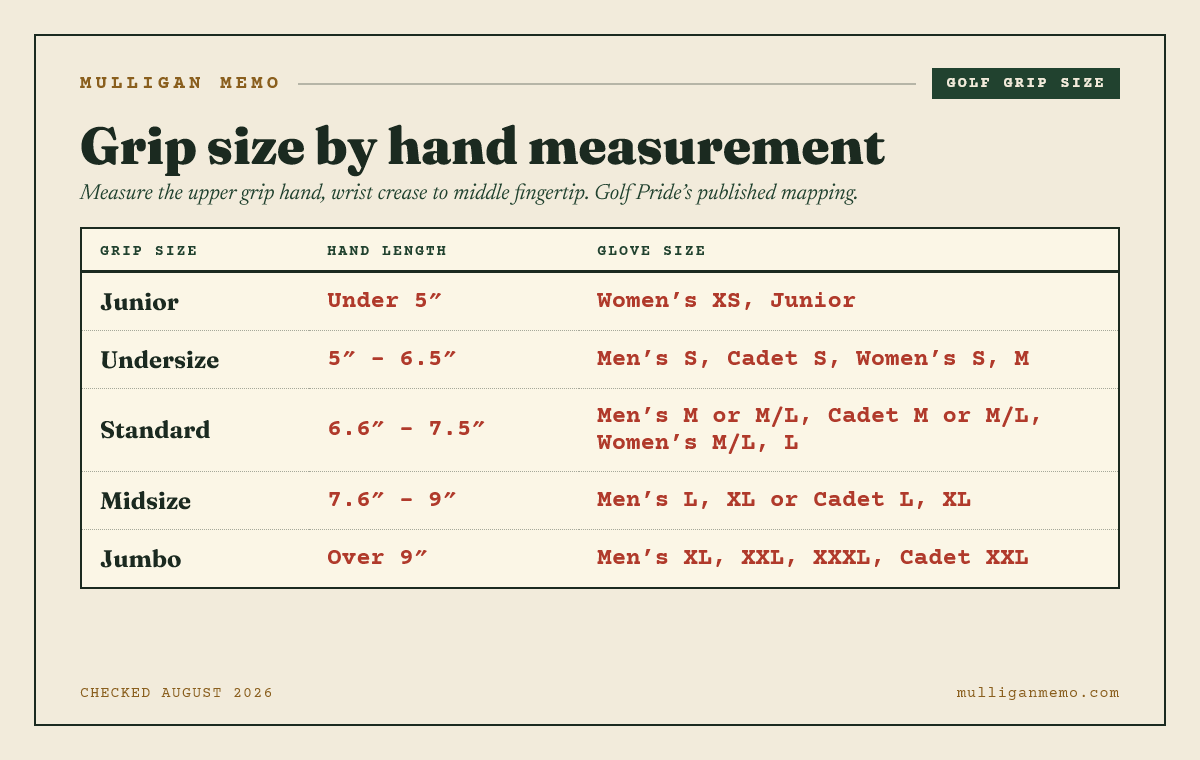
The catch“Midsize” is not a standard measurement
The chart above gets you to the right category. It does not get you to a diameter, because the size names are not standardised between manufacturers — the same problem that afflicts shaft flex and golf ball compression.
A midsize grip is usually about 1⁄16 of an inch larger than that brand’s standard. Usually. Hireko, who supply clubmakers and publish the component specifications, put numbers and names to it:
“A midsize grip is larger than men’s standard, but it could be +1⁄32″ (like offerings from Karma or Star Grip) or +1⁄16″ larger than men’s standard (Golf Pride, Lamkin and Winn). A jumbo grip for some manufacturer’s product lines might be +1⁄16″ or +1⁄8″, so it is possible a jumbo golf grip may be the same size as a midsize golf grip in another brand.” Hireko Golf, 5 Factors That Influence Grip Sizing
Read that last clause again, because it is the whole problem in one line: one brand’s jumbo can be the same diameter as another brand’s midsize. The word on the label is a marketing category, not a measurement.
It does not even hold within a single brand. Hireko’s clubfitting guide notes that Winn’s Excel RF midsize is +1⁄32″ over their men’s standard, while the midsize versions of Winn’s other models are listed at +1⁄16″. Same maker, same word, two different grips.
Which is why it is worth knowing the number the word is standing in for. These are the diameters those names correspond to, measured two inches down from the cap:
| Size name | Diameter, 2″ below the cap |
|---|---|
| Ladies −1⁄32″ | 0.819″ |
| Ladies standard | 0.850″ |
| Ladies +1⁄32″ | 0.881″ |
| Men’s −1⁄32″ | 0.869″ |
| Men’s standard | 0.900″ |
| Men’s +1⁄64″ | 0.916″ |
| Men’s +1⁄32″ | 0.931″ |
Notice what falls out of that table: a ladies +1⁄32″ grip measures 0.881″, which is thicker than a men’s −1⁄32″ at 0.869″. The two ranges overlap, so a grip sold as a women’s size can be the larger of the two.
There is a second variable that catches people out, and Golf Pride explains it themselves:
“Core size can affect how a grip feels in your hand. Typically, if the core size is smaller than the shaft diameter, it will feel firmer and bigger than its true size. For example, a .58 core standard size grip on a .600 shaft will feel thicker than a .60 core standard size grip on a .600 shaft.”Golf Pride, Swing Grip Size Guide
So the same grip, in the same size, fitted to two different shafts, is two different thicknesses. That is why a “standard” regrip can come back feeling fatter than the one it replaced, and why the honest sequence is: measure your hand, use the chart to pick a category, then check the actual grip you are buying rather than trusting the word on the label.
Step OneHow to measure golf grip size at home
You only need a straight ruler and your lead hand — that's the top hand on the club, the left hand for a right-handed golfer. This is the hand the chart is built around, so don't measure your trail hand by mistake.
- Lay the lead hand flat, palm up. Keep your fingers together but relaxed — not splayed apart, and not clenched.
- Find the wrist crease at the base of your palm — the main fold where your hand meets your wrist.
- Measure straight up to the tip of your middle finger. Lay the ruler flat along the hand and read the length from that wrist crease to the very end of the longest finger.
- Write down that single number. That length is what the golf grip size chart maps to a size.
Some fitters also measure hand width across the knuckles for a fuller picture, but for choosing a grip size, the wrist-to-fingertip length is the number that matters. One quick caution: if you measure your trail hand or splay your fingers, you'll read long and end up oversized. Palm up, fingers together, lead hand. That's the whole method.
"Measure the lead hand, palm up, fingers together — get that one number right and the chart does the rest."
The ChartGolf grip size chart by hand length
Here's the core golf grip size chart, using the widely cited Golf Pride convention (hand length measured wrist-crease to middle-fingertip). This is golf grip size by hand size in its simplest form — find your measured number on the left, read your size on the right.
| Hand length (lead hand) | Grip size | Who it tends to fit |
|---|---|---|
| Under 5" | Junior | Kids and very small hands |
| 5.0" – 6.5" | Undersize | Smaller hands, many women |
| 6.6" – 7.5" | Standard | Average adult hands |
| 7.6" – 9.0" | Midsize | Larger hands, light grip pressure |
| 9.0" and up | Jumbo / Oversize | Very large hands, quiet-hands seekers |
One important caveat before you trust any chart you find online: the numbers genuinely differ between sources. Some retailer charts fold in glove circumference rather than pure hand length, which pushes their "standard" range up toward 7"+ and shifts everything else. Neither is wrong — they're just measuring different things. The chart above uses pure hand length in the Golf Pride convention, so as long as you measured wrist-crease to fingertip, these ranges line up. If you see a conflicting chart, check what it's actually measuring before you switch sizes.
What grip "size" means in inches
Knowing your category is useful, but it helps to understand what the labels physically mean. Grip diameter is measured two inches down from the butt end of the grip, and the tiers step up in small, consistent increments:
| Size | Approx. diameter | Relative to standard |
|---|---|---|
| Undersize / ladies | ~0.840" – 0.870" | About −1/16" |
| Standard (men's) | ~0.900" | Baseline |
| Midsize | ~0.960" | About +1/16" (0.0625") |
| Jumbo / oversize | ~1.025" | About +1/8" (0.125") |
The jumps look tiny on paper — a sixteenth of an inch here, an eighth there — but your hands are sensitive enough to feel them clearly. That's also why the right size is worth getting right: a 1/16" change is the difference between a club that disappears in your hands and one you fight all day.
The glove-size cross-check (a handy backup)
If you don't have a ruler handy, your golf glove size is a useful second opinion. It's less precise than a measured hand length — two people in the same "medium" can have hands that differ noticeably — but it's a fine sanity check. The quickest move: read the size printed inside a glove you already own and match it below.
| Your glove size | Likely grip size |
|---|---|
| Men's S / Cadet S, women's gloves | Undersize |
| Men's M / ML | Standard |
| Men's L / XL (Cadet L / XL) | Midsize |
| Men's XXL and up | Jumbo |
When the glove check and the ruler agree, you can buy with confidence. When they disagree, trust the measured hand length and let the in-hand feel test (below) break the tie. A similar fit-first mindset applies all over the bag — our junior club size chart by height shows just how much proper sizing matters at the other end of the age range, too.
Standard vs midsize vs jumbo grips, in practice
The chart tells you a size; this section tells you what living with each one feels like. The standard vs midsize vs jumbo grips decision isn't only about hand length — it's about grip pressure, wrist activity, and comfort.
- Standard is the default on most off-the-rack clubs. If your hands measure into the standard range and nothing feels off, there's rarely a reason to change.
- Midsize (+1/16") suits larger hands and is also a popular comfort step-up. A slightly bigger grip naturally lowers how hard you squeeze, which many players find relaxes their hands and steadies tempo.
- Jumbo / oversize (+1/8") is a deliberate, noticeable change. It meaningfully quiets the hands and wrists — great for golfers fighting overactive hands, and a common recommendation for joint pain, but a real adjustment in feel.
Two refinements bridge the gaps between sizes. First, extra tape wraps let you build a standard grip up toward midsize (more on the math next). Second, Golf Pride's "Plus4" technology builds extra material into the lower hand only, so the upper hand stays standard while the lower hand feels like roughly four extra wraps — closer to midsize. That's a targeted fix for golfers whose trail/lower hand gets too active, without enlarging the whole grip.
Charts get you close; your hands confirm it. Place your lead hand on the club and look at where the middle and ring fingertips land. They should just barely touch the heel/thumb pad of your palm.
A clear gap — fingertips not reaching the pad — means the grip is probably too big. Fingertips digging hard into the palm means it's probably too small. This simple check catches sizing mistakes the chart can't, so always feel a club before you commit a full set.
Tape build-up: the cheap fine-tuning lever
Build-up tape is how fitters nudge a grip between sizes without buying a new one. The rule of thumb: one wrap of standard 3/4" double-sided grip tape adds roughly 0.015" to the finished diameter. Stack the math and it's easy to plan:
- ~4 extra wraps (≈ 0.060") approximates moving from standard toward midsize.
- Each wrap ≈ 0.015", so two wraps is a subtle bump, four is a real step.
- Don't over-wrap. Much beyond four wraps risks an uneven or torn grip. For a big size change, buy the correct grip rather than padding a standard one.
Treat those numbers as approximate — finished diameter depends on the tape's width and thickness and on the grip itself. The real value of build-up tape is as a cheap, reversible trial run: wrap up one club, play a few holes, and see whether the bigger feel actually helps before you re-grip the whole bag. If you want to do the work yourself, our step-by-step on how to regrip golf clubs at home covers tape, solvent, and the vise setup.
Ball FlightDoes grip size affect a hook or slice?
It can — but as a tendency, not a guaranteed cure. Grip diameter influences how freely your hands and wrists release the club through impact, and that shows up in the clubface:
- Grips that are too small let the hands and wrists get overly active, releasing the club early and closing the face — which exaggerates a hook or pull.
- Grips that are too big quiet the hands and restrict the release, leaving the face open — which exaggerates a slice or push, and often costs a little distance.
So if you fight a hook, a slightly larger grip may help calm overactive hands; if you fight a slice, going smaller might let your hands release more freely. But be honest with yourself about what a grip can do. Equipment editors and fitters are clear that grip size accentuates or mitigates a ball-flight tendency — it does not fix a swing fault. Don't expect a fatter grip to cure a slice rooted in your path or face control. Use grip size as one variable, and bring a coach or a professional fitting into the conversation before you "fix" ball flight with hardware.
Sizing up for comfort and joint pain
There's a fit reason to size up, and there's a comfort reason. A larger-diameter grip requires less grip pressure and reduces wrist hinge, which spreads load more evenly across the hand — the American Academy of Orthopaedic Surgeons notes that larger diameters distribute pressure better. That's exactly why midsize and oversize grips are so often recommended for golfers with arthritis or joint pain.
If sore hands are your main reason for reading a grip size chart, the comfort angle may matter more than the textbook fit, and many fitters suggest sizing up a tier beyond what your hand length says. The companion guide to the best golf grips for arthritic hands covers soft, low-pressure options and is worth a read before you buy if comfort is the priority.
Our PicksGrips worth considering once you know your size
Once the chart has pointed you to a size, these reputation-tested grips cover the full range from a no-frills standard baseline to dedicated jumbo and putter options.
Golf Pride Tour Velvet (incl. Tour Velvet 360)
The longtime default grip on countless off-the-rack clubs and a perennial best-seller. It's an all-rubber, medium-firm grip with a proven, neutral feel that suits most players and most conditions. Crucially for this guide, it's offered across the full size range — undersize, standard, midsize, and jumbo — so once you've measured your hands, it's an easy, affordable way to get exactly the right size in a grip people trust.
Golf Pride MCC Plus4
A multi-compound grip with cord-infused material in the upper hand for control and softer rubber in the lower hand for feel. Its signature feature is "Plus4" technology, which builds the lower hand up to feel like roughly four extra tape wraps — nearer midsize — without enlarging the upper hand. It's popular on tour and with everyday players, with a reputation for reducing grip pressure and quieting an overactive trail hand.
Lamkin Crossline (and Crossline Cord)
A long-standing, value-oriented grip known for an aggressive surface pattern and a firm feel that delivers strong traction — especially the corded version in wet weather or for sweaty hands. It's available in multiple sizes, including midsize. Honest trade-off: the firm, textured surface feels rougher on bare hands than soft rubber and is less plush than tackified grips, so it's a feel preference as much as a size one.
Winn Dri-Tac
One of the most popular soft, tacky grips, valued for a cushioned feel and a surface that stays tacky in wet conditions without cord. It's frequently recommended for golfers with arthritis or joint pain because the soft, low-pressure feel is easy on the hands, and it's offered in oversize for those who need to size up. Honest trade-off: softer polymer grips wear out faster than cord or multi-compound grips, so expect to re-grip a bit sooner.
JumboMax (Tour Series and other models)
A brand that makes only oversize and jumbo grips, so the entire lineup is engineered around large diameters that reduce hand tension and quiet wrist action — best known via high-profile tour usage. The Tour Series is the firmest, most traditional-feeling option. Honest note: jumbo diameters are a significant change from standard. They meaningfully reduce hand and wrist activity, which helps some players and over-quiets others, so they're a deliberate choice rather than a default.
SuperStroke (Traxion / Cross Comfort putter grips)
The market-leading oversize putter-grip brand, known for non-tapered, larger-diameter shapes that quiet the wrists in the putting stroke to promote a more shoulder-driven, consistent roll. Its reputation is strongest specifically on the putter, not full-swing clubs. Honest note: oversize putter grips are a feel preference — they help many golfers reduce wristy strokes but aren't universally better, so try before committing.
If you'd rather see the picks side by side, here's the same lineup as a quick decision matrix. "Comfort" rates how soft and forgiving the grip feels in hand; "Traction" rates how aggressively it grips back in sweat or rain. Match the row to what you're solving for.
| Grip | Best for | Sizes | Comfort | Traction |
|---|---|---|---|---|
| Golf Pride Tour Velvet | Reliable no-frills baseline | Under / Std / Mid / Jumbo | Medium | Medium |
| Golf Pride MCC Plus4 | Between sizes / busy lower hand | Standard (Plus4 lower) | Medium | High |
| Lamkin Crossline | Max traction, firm feel | Multiple, incl. midsize | Low | High |
| Winn Dri-Tac | Comfort / arthritis | Standard + oversize | High | Medium |
| JumboMax (Tour Series) | Dedicated jumbo, quiet hands | Oversize & jumbo only | Medium | Medium |
| SuperStroke Traxion | Wristy putting strokes | Oversize putter grips | High | Medium |
One note on that last pick: putter-grip sizing is its own world. An oversize putter grip is chosen to quiet the wrists on the green, not because your hands measure jumbo — so your putter grip doesn't need to match your full-swing grip size. Keep the two decisions separate.
Avoid TheseCommon grip-sizing mistakes
Most sizing regrets trace back to a handful of repeat offenders. Run through this list before you commit a whole set to a size:
- Measuring the trail hand. The chart is built around the lead hand — the top hand on the club. Measure the wrong one and you'll read long and end up oversized.
- Splaying the fingers. Fingers fanned apart stretches the reading. Keep them together and relaxed, palm up.
- Trusting an online chart without checking what it measures. Some retailer charts fold in glove circumference instead of pure hand length, which shifts every range. Confirm the chart matches the wrist-crease-to-fingertip method before you switch sizes.
- Skipping the in-hand feel test. Hand length is a starting point, not a verdict. Put your lead hand on the club and run the fingertip check before buying — it catches mistakes the chart can't.
- Over-wrapping with tape. Build-up tape is great for a one-club trial, but much past four wraps risks an uneven or torn grip. For a real size change, buy the correct grip.
- Matching your putter grip to your full-swing size. An oversize putter grip is chosen to quiet the wrists on the green, not because your hands measure jumbo. Keep the two decisions separate.
- Expecting a grip to fix a swing fault. Grip size accentuates or mitigates a ball-flight tendency; it doesn't cure a path or face problem. Bring a coach or fitter into that conversation.
The last word
Start with the ruler: lead hand, palm up, fingers together, wrist crease to middle-fingertip. Drop that number onto the chart, cross-check it against your glove, then — most importantly — put your hands on a club and run the fingertip test before you commit a full set. If you're between sizes, a few wraps of build-up tape is a cheap, reversible way to feel the difference before you buy. And remember the honest part: hand length is the starting point, not the final word. Your swing tendencies, grip style, and personal feel matter just as much, and a hands-on feel test (ideally a quick professional grip fitting) beats any chart when you're trying to correct a ball-flight problem. For more plain-English gear advice, keep an eye on Mulligan Memo.
Our grip weight chart covers the other specification on the sheet, and what a regrip does to swing weight.
FAQQuick answers
How do I measure my hand for the right golf grip size?
Lay your lead hand flat with the palm up and fingers together (not splayed), then measure with a straight ruler from the wrist crease at the base of your palm to the tip of your middle finger. That single length maps to a grip size on the chart. Use your lead hand specifically — the top hand on the club — not your trail hand.
What size golf grip do I need — undersize, standard, midsize, or jumbo?
Using hand length (wrist crease to middle-fingertip): under 5" is junior, 5.0–6.5" is undersize, 6.6–7.5" is standard, 7.6–9.0" is midsize, and 9"+ is jumbo. Most average adult hands land in the standard range. Confirm with the in-hand fit test — your lead-hand fingertips should just barely touch the pad of your palm.
Can I use my golf glove size to figure out my grip size?
Yes, as a backup cross-check. Roughly: men's S / cadet S and women's gloves point to undersize, men's M/ML to standard, men's L/XL (cadet L/XL) to midsize, and men's XXL and up to jumbo. Just read the size printed inside a glove you already own. Glove size is less precise than a measured hand length, so when the two disagree, trust the ruler.
What's the difference between standard, midsize, and jumbo grips, and how much bigger is each?
Diameter is measured two inches from the butt end. Standard is about 0.900", midsize adds roughly +1/16" (about 0.960"), and jumbo/oversize adds roughly +1/8" (about 1.025"); undersize is about −1/16" under standard. The steps are small in inches but very noticeable in hand. Beyond size, bigger grips lower grip pressure and quiet the hands; smaller grips free up the hands and wrists.
How many extra wraps of tape make a grip midsize, and how much does one wrap add?
One wrap of standard 3/4" double-sided grip tape adds roughly 0.015" to the finished diameter, so about four extra wraps (≈ 0.060") approximates moving from standard toward midsize. These are approximate — the exact result depends on tape thickness and the grip itself. Don't go much beyond four wraps; over-wrapping risks an uneven or torn grip, so for a big change, buy the correct grip instead.
What is Golf Pride "Plus4," and is it the same as adding tape wraps?
Plus4 technology builds extra material into the lower hand only, so the upper hand stays standard while the lower hand feels like roughly four extra wraps — closer to midsize. It's similar in effect to building up the lower hand with tape, but it's engineered into the grip and targets the trail/lower hand specifically. It's useful for golfers whose lower hand gets too active.
Does grip size affect a hook or a slice — can a bigger grip fix my hook?
It influences ball flight as a tendency, not a guaranteed fix. Grips that are too small let the hands release early and close the face, exaggerating a hook or pull; grips that are too big quiet the hands and leave the face open, exaggerating a slice or push and often costing distance. A bigger grip may help calm an overactive-hands hook, but it won't cure a swing fault — treat it as one variable and see a coach or fitter.
How do I tell if my golf grips are too big or too small?
Use the in-hand check: with your lead hand on the club, your middle and ring fingertips should just barely touch the heel/thumb pad of your palm. A clear gap (fingertips not reaching the pad) means the grip is likely too big; fingertips digging hard into the palm means it's likely too small. It's a fast, reliable way to confirm what the chart suggests.
Are bigger (oversized) grips better for arthritis or hand pain?
They're a legitimate, commonly recommended option. A larger diameter requires less grip pressure and reduces wrist hinge, spreading load more evenly across the hand — the American Academy of Orthopaedic Surgeons notes larger diameters distribute pressure better. For joint pain, many fitters suggest sizing up a tier beyond the chart and choosing a soft, tacky grip for comfort.
Should I size my grips by hand size alone, or does my swing matter too?
Hand size is the starting point, not the verdict. Swing tendencies, grip style, and personal feel matter just as much. The best practice is to measure your hand, narrow it with the glove and fingertip checks, then do a hands-on feel test — and ideally a professional grip fitting — before using grip size to correct a ball-flight problem.
Do all my clubs need the same grip size?
For full-swing clubs, yes — keeping driver through wedges at one size means your hands feel the same on every shot, which is the whole point of fitting a size. The one club that plays by different rules is the putter: an oversize putter grip is chosen to quiet the wrists on the green, not to match your hand measurement, so it's perfectly normal to run a jumbo putter grip with standard grips on everything else.
Should I just size up for comfort even if my hands measure standard?
It's a reasonable choice if comfort is your goal. A larger diameter requires less grip pressure and reduces wrist hinge, so many golfers — especially those with sore hands or arthritis — intentionally go a tier above what their hand length says. The trade-off is that a bigger grip also quiets the hands and can leave the face open, which may nudge a slice. The cheap way to test it: build one club up with a few wraps of tape and play a few holes before committing the whole bag.
How often should I replace my grips?
A common rule of thumb is about once a year, or every 40 or so rounds, for an active golfer — sooner if you play a lot, sweat heavily, or favor a soft polymer grip like a tacky comfort model, which wears faster than cord or multi-compound grips. The tell is feel: when a grip turns slick, shiny, or hard, you start squeezing harder to hold on, which works against everything a properly sized grip is meant to do.