Golf Club Distance Chart: How Far Should You Hit Each Club?
The honest answer to golf's most-Googled question — plus why these numbers are rough averages, not promises, and how to find the only distances that actually matter: yours.
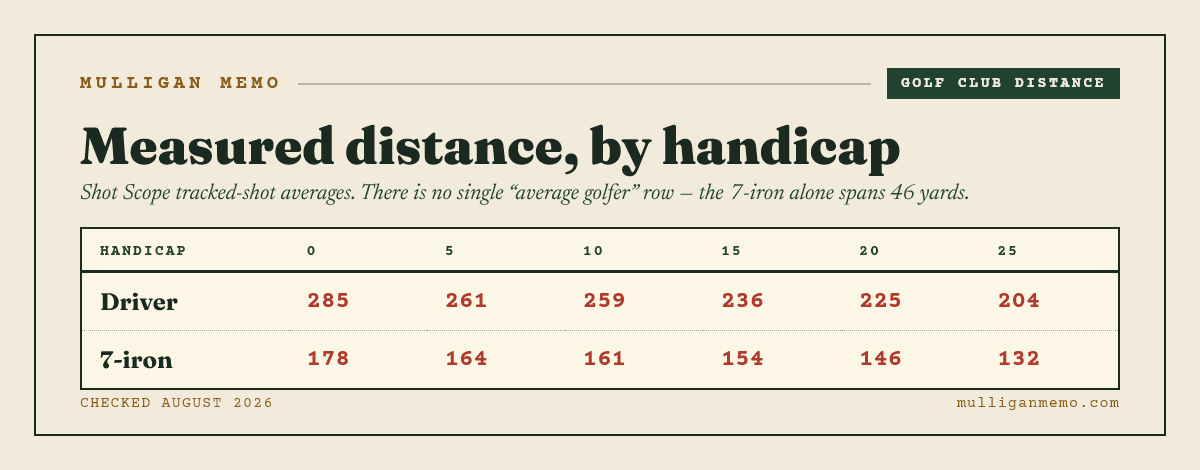
The chart below is the only full-bag distance table we could trace to measured shots: Shot Scope's performance averages by handicap, driver to lob wedge, as published through its media partners, with TrackMan's PGA Tour carry alongside. Read your handicap column, not the "average golfer". A scratch player's 7-iron is 178 yards; a 20 handicap's is 146. And note the argument in the sources: Golf Monthly labels these figures total distance in one article and carry in another, and Shot Scope itself does not explicitly define carry versus total. Treat them as what a well-struck shot travelled, and measure your own.
"How far should I hit each club?" gets answered online with a chart nobody measured. This one was. Shot Scope tracks every shot its users hit, drops the outliers, and publishes the result by handicap; TrackMan measures tour players by radar. Here they are, side by side, with the labels the publishers actually used.
The ChartGolf club distance chart by handicap
| Club | Scratch | 5 hcp | 10 hcp | 15 hcp | 20 hcp | 25 hcp | PGA Tour, carry |
|---|---|---|---|---|---|---|---|
| Driver | 285 | 261 | 259 | 236 | 225 | 204 | 282 |
| 3-wood | 261 | 234 | 227 | 215 | 195 | 178 | 249 |
| 4-iron | 223 | 201 | 199 | 186 | 169 | 151 | 209 |
| 5-iron | 200 | 183 | 187 | 169 | 162 | 143 | 199 |
| 6-iron | 185 | 172 | 171 | 162 | 151 | 137 | 188 |
| 7-iron | 178 | 164 | 161 | 154 | 146 | 132 | 176 |
| 8-iron | 166 | 153 | 150 | 146 | 138 | 122 | 164 |
| 9-iron | 155 | 139 | 140 | 136 | 129 | 108 | 152 |
| Pitching wedge | 141 | 126 | 127 | 121 | 108 | 90 | 142 |
| Gap wedge | 126 | 109 | 110 | 104 | 94 | 79 | — |
| Sand wedge | 105 | 86 | 98 | 84 | 85 | 80 | — |
| Lob wedge | 86 | 71 | 79 | 75 | 78 | 49 | — |
Handicap columns: Shot Scope performance averages for male golfers, as published by MyGolfSpy (January 2025) and Golf Monthly (March 2025, four columns). Shot Scope's own blog carries the scratch, 5, 10 and 20 handicap driver figures. Golf Monthly's March 2025 article says of these figures "that's total distance, not carry"; its June 2026 article prints the same 7-iron numbers labelled carry; Shot Scope's definition pages do not explicitly define carry versus total. Shot Scope's "P-Avg" removes outlier shots and excludes positional shots and anything hit within 50 yards of the pin. Tour column: TrackMan 2023 season averages, carry, as transcribed by Golf Monthly, February 2025. These Shot Scope tables omit hybrids and 5-woods. Checked September 2026.
Two things stand out before you compare yourself to it. The 25-handicap wedge rows are odd, a sand wedge at 80 and a lob wedge at 49. Neither publisher gives shot counts, so we cannot say why; thin data in the highest band is our guess, not a finding. And the tour column is measured as carry while the handicap columns are, by Golf Monthly's own label, probably total. So a scratch amateur's 178-yard 7-iron and a tour player's 176 carry are not two yards apart; the tour ball is in the air for all of its 176 and then rolls.
Off the tee: every measured average is below the chart you have seen
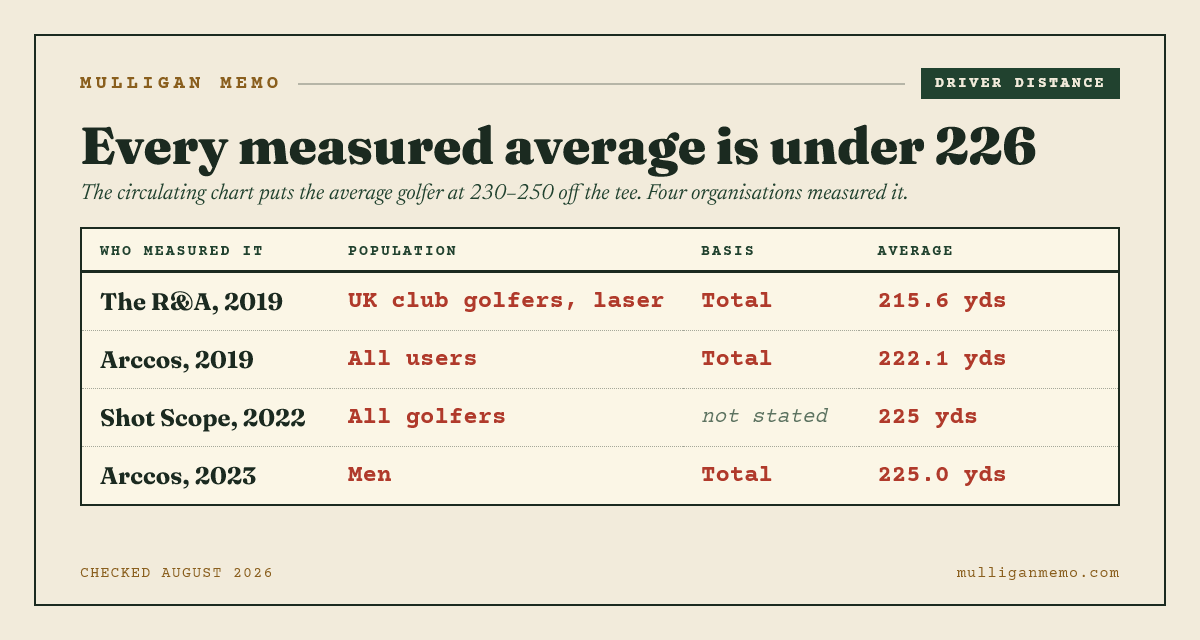
The circulating chart tends to put the average golfer at 230 to 250 yards off the tee. Every measured population mean lands under it.
| Source | Population | Basis | Average driver |
|---|---|---|---|
| The R&A, 2019 | UK club golfers, laser-measured, all tee shots (driver on 88.2%) | Total | 215.6 yds |
| Arccos, 2019 | All users | Total | 222.1 yds |
| Shot Scope, 2022 | All golfers | not stated | 225 yds |
| Arccos, 2023 data | Men | Total | 225.0 yds |
| Arccos, 2025 data (2026 report) | Men (37,000+ golfers in the full sample) | Total | 224.1 yds |
Shot Scope also publishes the spread behind its average, and the spread is the more useful number: 19% of amateurs average under 200 yards, 76% average under 250, and only 2% average over 300.
The R&A's laser measurements make the same point more starkly. Measuring UK club golfers off the same tees in the same competitions in 2018, they found the 10th percentile at 159 yards, the median at 219, and the 90th percentile at 266. Anyone comparing themselves against one number in a table is comparing themselves against a fiction.
Through the bag: where the full chart actually comes from
Shot Scope does not publish the full table on its own site. Its blog gives the driver for scratch, 5, 10 and 20 handicaps, and a whole-database driver and 3-wood average, 225 and 203 yards, from what it describes as 80 million shots. The club-by-club columns above reach the public through its media partners, which is why the carry-or-total question has two answers. Arccos, the other on-course tracker, compared three clubs in a 2020 article:
Arccos measures the same clubs differently — the median distance a shot actually travelled, with mishits and freak long shots filtered out:
| Club | Scratch | 10 handicap | 20 handicap |
|---|---|---|---|
| 5-iron | 176 | not published | 152 |
| 7-iron | 159 | 148 | 140 |
| Pitching wedge | 122 | 114 | 104 |
Arccos Smart Distance, published April 2020. Basis not stated on the page; Arccos states at platform level that its distances are total, “based on where your ball ‘ends up’.” The same article describes its Smart Distance feature, which excludes mishits and abnormally long shots, but does not say whether these medians are the filtered figures.
The two biggest amateur datasets disagree. On a scratch golfer's 7-iron, Shot Scope says 178 and Arccos says 159 — nineteen yards apart, from the two companies with the most tracked shots in golf. Neither is wrong on its own terms; they measure and filter differently. But they cannot both go in one row, which is exactly what every aggregated chart does to them.
One thing worth saying plainly, because it cuts against the easy story: the generic iron numbers are not badly wrong. The familiar “7-iron, 140 to 150 yards” sits at the low end of where measured 10-to-20 handicap golfers actually sit. What is wrong is the pretence of a single row — measured 7-iron distance runs from 178 down to 132 across the handicap ladder, a 46-yard spread that one line hides.
Two caveats on everything above. Loft is not standardised, so a “7-iron” from a modern game-improvement set is stronger-lofted than a classic 7-iron of the same name and will carry meaningfully farther — see our guide to loft for why the number on the sole is not the whole story. And these datasets are not a random sample of golfers. Arccos and Shot Scope users are golfers who chose to track their game, and neither company addresses that self-selection anywhere. The R&A's amateurs were UK club golfers at six venues, measured up to 2019.
The Real FindingThe club you pull vs the shot you hit
This is the most useful thing in any of the measured data, and almost nobody publishes it. Arccos records two numbers for every approach shot: the yardage the golfer was facing when they pulled the club, and how far the ball actually went. The gap between those two widens sharply as handicap rises.
| Club and player | Yardage faced | Distance actually hit | Short by |
|---|---|---|---|
| 7-iron, scratch | 170 | 159 | 11 yds |
| 7-iron, 10 handicap | 165 | 148 | 17 yds |
| 7-iron, 20 handicap | 162 | 140 | 22 yds |
| 5-iron, scratch | 194 | 176 | 18 yds |
| 5-iron, 20 handicap | 187 | 152 | 35 yds |
| 3-iron, 20 handicap | 213 | 162 | 51 yds |
| 3-hybrid, 20 handicap | 220 | 163 | 57 yds |
Arccos, published 2020. Read this carefully: the gap is not pure optimism. It also contains mishits, deliberate lay-ups, and shots played to a spot rather than at the flag. But the direction and the slope are unambiguous, and they come from the club-selection records of a company measuring hundreds of millions of shots.
A 20-handicapper reaches for a 5-iron from 187 yards and, by Arccos's median, hits it 152. The club is chosen for a distance it rarely travels.
That is a more valuable insight than any row in a distance chart. The common error is not misjudging the yardage to the pin — rangefinders solved that. It is choosing the club you hit once, on your best strike, rather than the one you hit on a normal Tuesday.
There is a related finding from The R&A worth putting beside it: in 2019, golfers in the 21-and-above handicap category used a driver on 96.7% of measured tee shots, while golfers with handicaps below six used one on 84.5%.
The Other NumberCarry vs. total: what the sources actually label
The first question people ask about any chart is whether it is carry or total, and the honest answer for this one is that the publishers disagree. TrackMan's tour figures are carry, stated as such. Shot Scope's handicap figures are called total by Golf Monthly in March 2025 and carry by the same magazine in June 2026, and Shot Scope's own definition of its performance average never says. Arccos states at platform level that its distances are based on where the ball ends up, which is total.
Nobody measured publishes a roll figure per club, so this page will not give you one. What the labels do tell you is how to compare: a tour carry number and an amateur total number are different measurements, both expressed in yards, and lasering your ball at rest gives you total, which flatters every club you hit off firm ground. Club for the number you can control, which is carry, and find yours the way the section further down describes.
Two More ColumnsWomen and seniors: what is actually measured
The full-bag chart above is male golfers. No measured source we could find publishes a club-by-club table for women or for golfers over 60, so this section gives the driver figures that are measured and stops there rather than scaling the men's chart by a guess.
| Population | Driver | Basis | Source |
|---|---|---|---|
| Women, all Arccos users, 2024 data | 176.2 yds | Total | Arccos annual report |
| Women in their 20s | 201.0 yds | Total | Arccos 2026 report |
| Women in their 60s | 158.0 yds | Total | Arccos 2026 report |
| Women, handicap 0 to 4.9 / 30 and over | 220.0 / 145.0 yds | Total | Arccos 2026 report |
| Men, 15 to 19 | 240.0 yds | Total | Arccos 2026 report |
| Men in their 70s | 190.0 yds | Total | Arccos 2026 report |
| LPGA Tour | 223 yds | Carry | TrackMan, 2023 season |
Arccos Golf, Driving Distance Report 2026 Edition (2025 data, on-course, total distance including roll) and the 2025 edition (2024 data) for the women's overall average; TrackMan 2023 tour averages, carry. Checked September 2026.
The Arccos age rows are the useful ones. Men in their seventies average 190 yards off the tee, fifty behind the teenagers, and women in their sixties 158. If you are a slower swinger, the lever is not a different chart; it is launch. A higher-launching, lower-spinning setup gets more carry out of the speed you have, and the driver for seniors page is built around exactly that.
The Real DriverDistance by swing speed: the measured rows
Club speed is the variable doing most of the work in the chart above, and TrackMan publishes it by the same handicap bands, from its Combine testing. Put the two tables together and the ladder is visible: the club speed column falls eighteen miles an hour from scratch to bogey golfer, and the driver column in the chart above falls sixty yards over the same span, 285 to 225.
| Men, driver | Club speed | Ball speed | Smash factor | Shot Scope driver, same band |
|---|---|---|---|---|
| PGA Tour | 115 mph | 171 mph | 1.49 | 282 carry (TrackMan) |
| Scratch or better | 110 | 161 | 1.49 | 285 |
| 5 handicap | 101 | 147 | 1.45 | 261 |
| 10 handicap | 95 | 138 | 1.45 | 259 |
| Average golfer (14.5) | 94 | 133 | 1.44 | 236 (15 hcp) |
| Bogey golfer | 92 | 131 | 1.43 | 225 (20 hcp) |
TrackMan, Combine averages by handicap and 2023 tour averages, articles dated 23 September 2024. The last column repeats the Shot Scope driver figure for the nearest handicap band from the chart above; the two datasets are different golfers, so read it as a pairing, not a measurement of the same swing.
If you know your club speed from a fitting or a radar, the ball speed chart turns it into ball speed and shows what a clean strike is worth at your speed. It is a better predictor of your row in the chart than your age, and the age tables online disagree with each other by more than ten miles an hour.
Why Clubs DifferDistance by loft: why the same number goes different distances
Club-to-club distance is mostly a loft story, and loft is why distance charts disagree with each other. A 7-iron is not a fixed thing: the makers stamp the number on heads with lofts several degrees apart, and a strong-lofted game-improvement 7-iron carries what a traditional 6-iron does. Our golf club loft chart sets the makers' published lofts side by side, model by model, which is the only honest way to see it. Before you conclude you are short with a 7-iron, check what loft your 7-iron actually is.
Do ThisHow to find YOUR real distances
This is the most important section on the page. A chart of averages is a conversation starter; your own measured carries are what you actually club with. There are three reliable ways to get them, from most precise to most realistic.
Blank on purpose — fill in your own carries, print two bag-sized copies per sheet, or save it as a PDF.
- Launch monitor (most precise). A range session or fitting on a launch monitor gives you exact carry numbers for every club in under an hour, and separates carry from roll so you're not fooled by a hot bounce. It's the gold standard. You don't need to own one — many ranges and golf shops have them — but if you want to practice with data at home, see our best launch monitors under $500.
- Rangefinder or GPS (most realistic). Measuring real shots on the course captures how you actually swing under pressure, with real lies and nerves — which is usually a bit shorter than your range "showroom" numbers. One honest caveat: lasering the spot where your ball came to rest gives you total distance (carry plus roll), not carry — and a GPS app shares the caveat, since it measures to wherever you're standing, which is the ball at rest. To measure carry, shoot the pitch mark or the spot where the ball first landed — easiest on soft fairways and greens that hold a mark — or let a launch monitor separate carry from roll for you. Track both over several rounds: carry is what clears the bunker; total is where you'll putt from. Our guides to the best rangefinders under $100 and rangefinder vs. GPS cover the tools.
- Shot tracking over a season (most thorough). Sensor or app-based tracking logs every shot you hit and averages them automatically, smoothing out the good and bad strikes into a number you can trust. It takes time but needs no effort once it's set up.
Do not club off your best-ever strike. Everyone remembers the one 7-iron they flushed 165 — and then comes up short on that club for the rest of their life. Your usable distance is your typical, repeatable carry: the shot you'd bet on landing eight times out of ten, not your highlight reel. Measure several shots per club, throw out the outliers, and use the middle.
The Real LessonWhy gaps matter more than raw yards
Here's the part the average-distance question usually misses entirely. How far you hit each club matters far less than how evenly your clubs are spaced. The whole point of carrying 14 clubs is to have a club for every yardage you'll face. If two clubs go the same distance, one of them is wasted; if there's a 25-yard hole between two clubs, every shot that lands in that hole becomes an awkward half-swing guess.
Good gapping usually means roughly 10–15 yards between full-swing clubs — tighter through the scoring clubs, a bit wider through the long clubs. Most amateurs, when they finally measure, discover two problems: their long irons bunch together (a 4-iron and 5-iron that carry within a few yards of each other), and there's a yawning gap between their pitching wedge and sand wedge that a gap wedge was invented to fill.
The fixes are cheap relative to the strokes they save. A hybrid in place of a hard-to-hit long iron restores a real distance step at the top of the bag. A properly chosen wedge setup closes the holes at the bottom — and our roundup of the best wedges under $100 shows you don't need to spend tour money to do it. If you're still assembling a bag, our take on how many clubs a beginner actually needs and the best beginner sets under $500 both lean on this same gapping logic.
So chase distance if it's fun — and the right distance ball or well-fit irons can genuinely help — but understand that clean, consistent gaps will lower your scores more reliably than five extra yards off the tee ever will. And if you want the fundamentals behind the numbers, our golf ball buyer's guide explains how the ball itself nudges carry and spin.
The Gap Lab: find the hole in your bag
Enter your typical distance for each club you carry, carry or total, but the same basis for every club. The preset fills Shot Scope's 15-handicap figures, whose basis the publishers dispute. Everything stays in your browser.
Enter your typical carry, not your best-ever strike — the shot you'd bet on eight times in ten. This maps the gaps between your clubs; it won't tell you what loft or shaft to buy.
FAQQuick answers
What is the average driver distance for an amateur golfer?
Under 226 yards in every source compared here. The R&A's laser-measured UK club golfers averaged 215.6 yards in 2019 and Arccos's 37,000-plus users averaged 224.1 in 2025, both total distance with roll. Shot Scope's handicap figures run from 285 at scratch to 204 at a 25 handicap. TrackMan's PGA Tour average is 282 yards of carry.
How far does the average golfer hit a 7-iron?
There is no single answer, and the measured data is the reason. Shot Scope’s tracked-shot averages run from 178 yards at scratch down to 132 at a 25 handicap — a 46-yard spread. Arccos, measuring the median distance a 7-iron actually travelled, publishes 159 for a scratch golfer, 148 at 10 and 140 at 20. The two disagree at the scratch end by 19 yards. If you want one band, Shot Scope puts 10-to-20 handicap golfers at 146 to 161 and Arccos at 140 to 148. The 7-iron is the club most people use as their personal yardstick, but there's huge spread between players, so the only number that matters for your game is the one you actually carry on the course.
Are these golf club distances carry or total distance?
The publishers disagree, and this page says so rather than picking one. TrackMan's tour column is carry. Shot Scope's handicap columns are labelled total by Golf Monthly in one article and carry in another, and Shot Scope's own definition of its performance average does not explicitly define carry versus total. Arccos states its distances are based on where the ball ends up, which is total.
Why does this chart give one number per handicap instead of a range?
Because that is what the measured source publishes: a performance average per club per handicap band, with outliers removed. A range would be ours, not theirs. The spread between bands is the honest range: a 7-iron runs from 178 at scratch to 132 at a 25 handicap, and two golfers with the same handicap can sit anywhere in it.
Should I worry more about how far I hit each club or the gaps between them?
The gaps. Raw distance is fun to talk about, but consistent gaps — usually 10–15 yards between full-swing clubs — are what let you cover every yardage on the course without two clubs that go the same distance or a big hole between clubs. Most amateurs have at least one overlap (often two long irons or wedges that carry nearly the same) and at least one gap. Fixing gapping with a gap wedge, a hybrid, or a loft adjustment improves scoring more than chasing five extra yards off the tee.
How far should I hit my driver for my swing speed?
TrackMan's measured rows put a 10 handicap at 95 mph of club speed and Shot Scope puts the same band at 259 yards; a bogey golfer is 92 mph and 225 yards; scratch is 110 mph and 285. Those are two different sets of golfers, so treat it as a pairing. The ball speed chart on this site turns your own club speed into ball speed, which is the number that actually sets carry.
Does loft affect how far each golf club goes?
Yes, and it is why charts disagree. The makers stamp the same iron number on heads with lofts several degrees apart, so one 7-iron carries what another maker's 6-iron does. Check the published loft of your own set on the golf club loft chart before deciding you are short.
How do I find out how far I actually hit each club?
Three good options. A launch monitor at a range or fitting gives you precise carry numbers for each club in one session — the gold standard. A rangefinder or GPS lets you measure real on-course shots over time, which captures how you actually play under pressure — just remember that shooting the ball at rest gives you total distance; laser the spot where it first landed to get carry. And shot-tracking systems or apps log every shot you hit over a season and average them. For real, usable numbers, ignore your single best strike and use a typical, repeatable carry.