Golf Club Loft Chart: What the Makers Actually Publish
Iron lofts from nine current Titleist and PING sets, taken from their own spec tables — and a gap checker that finds the holes in your own set.
Jump to a section
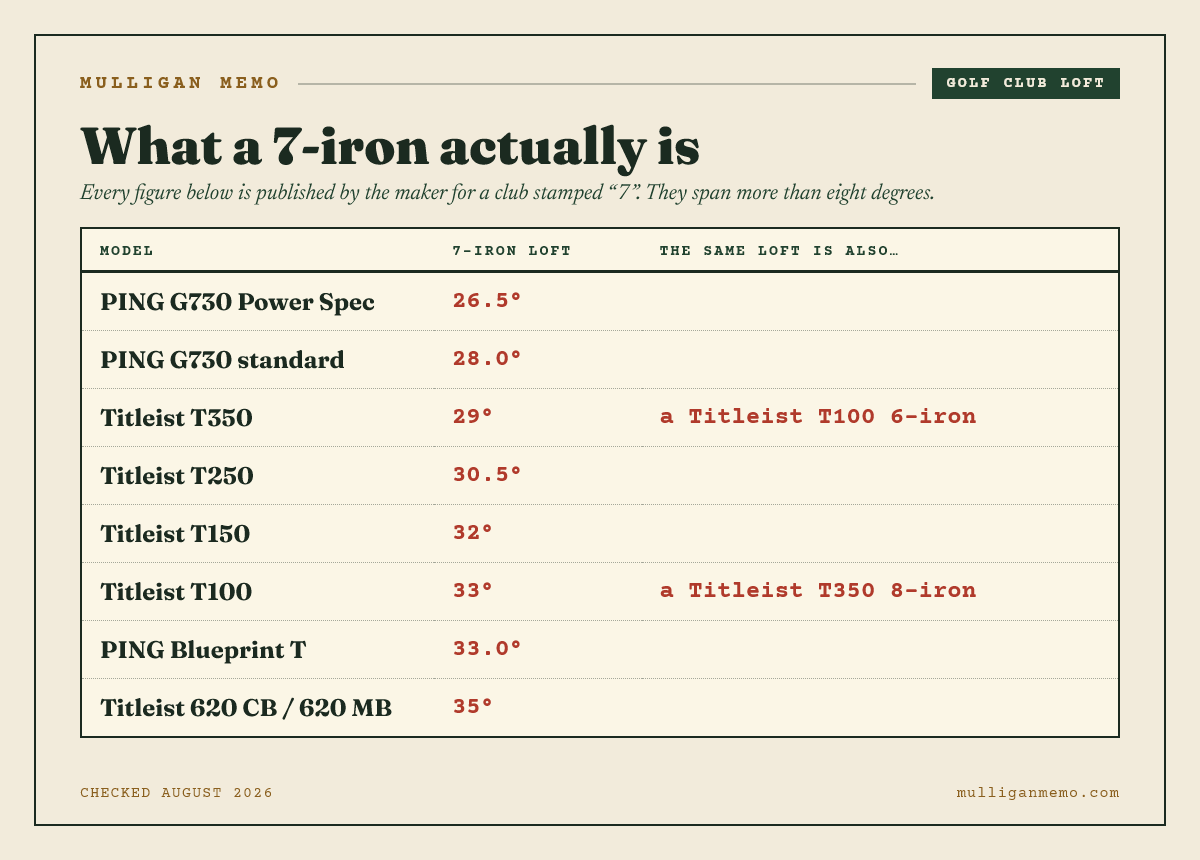
There is no standard 7-iron loft. Among current models from just two manufacturers, a 7-iron runs from 26.5° to 35° — a spread of more than eight degrees, all of it published by the makers themselves. A PING G730 8-iron (32°) and a PING Blueprint T 7-iron (33°) are one degree apart. So the useful question is not "what loft is a 7-iron," it is what are the gaps between the clubs you actually own. The checker below answers that one.
Nearly every loft chart online presents a single column of numbers as though loft were a specification, like the size of a shoe. It is not. Loft is a design decision that changes from model to model, and the manufacturers publish the proof themselves. This page shows you their tables, and then does the only calculation that actually helps: the gaps in your own bag.
The ToolLoft gap checker
Enter the loft of each club you carry. They are usually stamped on the sole of the wedges and, on many sets, on the hosel or the back of the head; if not, your model's spec page will list them. Or load one of the verified sets below to see how a real set is spaced.
Enter at least two lofts to see your gaps.
Gap guidance is measured, not invented: across the nine current iron sets checked for this page, consecutive lofts step by 2° to 6°, and from the 6-iron down almost always by 3° to 5°. The checker flags anything outside the range those sets actually use. Sources are linked under each table below, all checked August 2026.
The EvidenceTitleist's current irons, model by model
Titleist publishes one table covering every iron in the current line. It is the clearest illustration available of what "loft" really means in a golf set, because it holds two other variables still while loft moves.
| Model | 3 | 4 | 5 | 6 | 7 | 8 | 9 | P | W |
|---|---|---|---|---|---|---|---|---|---|
| 620 MB | 21° | 24° | 27° | 31° | 35° | 39° | 43° | 47° | — |
| 620 CB | 21° | 24° | 27° | 31° | 35° | 39° | 43° | 47° | — |
| T100 | 20° | 23° | 26° | 29° | 33° | 37° | 41° | 45° | 49° |
| T150 | 19° | 22° | 25° | 28° | 32° | 36° | 40° | 44° | 48° |
| T250 | 20° | 22° | 24° | 27° | 30.5° | 34.5° | 38.5° | 43° | 48° |
| T250 Launch Spec | — | — | 27° | 31° | 35° | 39° | 43° | 47° | 52° |
| T350 | — | 20° | 23° | 26° | 29° | 33° | 38° | 43° | 48° |
| Length (all models) | 39.00″ | 38.50″ | 38.00″ | 37.50″ | 37.00″ | 36.50″ | 36.00″ | 35.75″ | 35.50″ |
| Lie (all models) | 61° | 61.5° | 62° | 62.5° | 63° | 63.5° | 64° | 64° | 64° |
Titleist, published iron specifications, cross-checked against the Custom Club Options Booklet (updated 1 June 2026). Both checked August 2026.
Look at the bottom two rows. Length and lie do not move at all. Every Titleist 7-iron in the line, from the bladed 620 MB to the game-improvement T350, is built to 37.00″ and 63°. The only thing that changes between models is loft — and it changes by six degrees.
The ConsequenceYour 7-iron is somebody else's 6-iron
Set the T100 and the T350 side by side and the pattern is exact. Through the middle of the set, the T350 is precisely one club stronger:
| Loft | T100 calls it | T350 calls it |
|---|---|---|
| 20° | 3-iron | 4-iron |
| 23° | 4-iron | 5-iron |
| 26° | 5-iron | 6-iron |
| 29° | 6-iron | 7-iron |
| 33° | 7-iron | 8-iron |
Five clubs, five exact matches. The same head angle carries a different number depending on which box it came in — and both boxes say Titleist, in the same catalogue, in the same year. A golfer moving from a T100 to a T350 and keeping "the same" 7-iron has quietly picked up four degrees of loft change in the strong direction.
This is the mechanism behind the distance claims. A set whose 7-iron is 29° will out-carry a set whose 7-iron is 33°, and neither club is behaving unexpectedly. Whatever else has changed about the head, the number stamped on the sole has moved too — and that alone accounts for a good deal of the gain. It is also why comparing your distances to anyone else's is close to meaningless unless you both know your lofts — a point worth keeping in mind alongside our golf club distance chart.
The AdmissionPING publishes three lofts for the same club
PING makes the point more explicitly than anyone. On the spec table for each iron they list not one loft but three: a standard, a Power Spec that is stronger, and a Retro Spec that is weaker. Same club, same number on the sole, three published angles.
| PING 7-iron | Power Spec | Standard | Retro Spec |
|---|---|---|---|
| G730 | 26.5° | 28.0° | 30.0° |
| Blueprint T | 31.5° | 33.0° | 35.0° |
PING, published specifications for the G730 and Blueprint T, checked August 2026.
Between those four corners, PING's own published range for a club called a 7-iron runs from 26.5° to 35.0°. That is eight and a half degrees of legitimate, factory-specified variation for a single club number, inside a single brand.
The same divergence reaches the wedges, where it matters most. PING's G730 set ends in a club marked W at 40°. The Blueprint T's pitching wedge is 45°. Both are the last iron in the set; both are, in the ordinary sense, a pitching wedge. They are five degrees apart, which for most golfers is not far off a full club.
The Practical PartWhy gapping is the only question that survives
If loft is not standard, then a chart of standard lofts cannot tell you anything about your set. What it can tell you — and what the checker at the top of this page does — is whether your clubs are evenly spaced.
The sets above are worth studying for that reason. Every one of them steps in an orderly progression: roughly 3° between the long irons, widening to 4° or 5° through the scoring clubs. The manufacturers space their own sets carefully. The trouble starts at the seam, where the set ends and your wedges begin.
That seam is where strong lofts do their real damage. A T350 set finishes with a 43° pitching wedge. A golfer who then puts a 56° sand wedge in the bag — a perfectly normal thing to own — has left a thirteen-degree hole between two clubs. Three or four clubs' worth of distance covered by one. The set is not faulty and the wedge is not faulty; the gap is a consequence of a strong pitching wedge meeting a traditional wedge, and nothing on either club warns you.
This is why the gap checker sorts by loft rather than by name. Names are unreliable; angles are not. Enter what you own, and the holes appear where they actually are.
Woods and hybridsWhere loft is a choice, not a spec
Irons arrive with their lofts decided for you. Drivers, fairways and hybrids do not — the loft is an option you select at purchase, which makes "standard" an even weaker idea at the top of the bag. Titleist's current range gives a fair picture of what is on offer:
| Club | Model | Published loft options |
|---|---|---|
| Driver | GT1 | 9°, 10°, 12° |
| GTS2 / GTS3 | 8°, 9°, 10°, 11° | |
| Fairway | GT1 | 15°, 18°, 21°, 24° |
| GTS2 | 13.5°, 15°, 16.5°, 18°, 21° | |
| Hybrid | GT1 | 20°, 23°, 26°, 29° |
| GT2 | 18°, 21°, 24° |
Titleist Custom Club Options Booklet, updated 1 June 2026. Checked August 2026.
Two things follow. A hybrid at 20° and a 4-iron at 20° are the same loft, so the choice between them is about how the head launches the ball and how the shaft feels, not about distance on paper. And because most modern drivers and fairways carry an adjustable hosel, the number printed on the head is a starting point that a fitter can move — usually by a degree or two in either direction, with the exact range stated by the manufacturer.
The last wordRead the angle, not the number
The honest summary of every loft chart, including this one, is that the number on the bottom of a golf club is a name rather than a measurement. It tells you where the club sits in its own set. It does not tell you what the club will do, and it cannot be compared across sets without the loft beside it.
That is not a scandal, and it is not a reason to distrust manufacturers — all of them publish the real figures, clearly, on the product pages linked above. It is only a reason to stop treating "7-iron" as a unit of measurement. Find your own lofts, run them through the checker, and look at the gaps. If there is a hole at the bottom of the bag, that is worth fixing; the rest is labelling.
Two neighbouring pages take this further: the club length chart, where a genuine published standard does exist, and the distance chart, where knowing your lofts is what makes the numbers mean anything.
FAQCommon questions
What is the standard loft of a 7-iron?
There is not one. Among current models from Titleist and PING alone, a 7-iron is published anywhere from 26.5° to 35°. Titleist's T350 7-iron is 29° and its 620 MB 7-iron is 35° — same brand, same catalogue. PING lists three different lofts for each of its own 7-irons, a standard plus a stronger Power Spec and a weaker Retro Spec. If you need to know your 7-iron's loft, look it up on your model's spec page or have it measured; no general chart can tell you.
What is loft inflation, or "strong lofts"?
It describes the practice of assigning stronger (lower) lofts to a given club number than was traditional, so that each club carries further. The effect is visible without any history: Titleist's T350 is exactly one club stronger than its T100 through the mid-irons, so a T350 7-iron at 29° matches the T100 6-iron at 29°. The distance gain is real, but it comes from the angle rather than from new technology, and it has to be paid for somewhere — usually with a bigger gap between the pitching wedge and the next wedge down.
How many degrees should there be between clubs?
Across the nine current sets checked for this page, consecutive lofts step by 2° to 6°. The long irons are usually spaced 2° to 3°, the scoring irons 3° to 5°, and the wedges 4° to 6°. Manufacturers space their own sets consistently, so problems rarely appear inside a set — they appear where the set ends and separately-bought wedges begin. A gap much wider than 6° means one club is doing the work of two.
My pitching wedge is 43° — what wedges do I need?
A 43° pitching wedge followed by a 56° sand wedge leaves a thirteen-degree hole, which is far wider than any gap inside a manufactured set. Filling it usually takes two wedges rather than one, spaced to keep every step in the 4° to 6° range that the makers themselves use — for example 48° and 52° before the 56°. Run your actual lofts through the checker above rather than guessing, since the answer depends entirely on where your set ends.
Can loft be adjusted on irons?
Yes. Forged and cast irons can both be bent by a clubfitter using a loft and lie machine, and it is routine work. How far a given head can safely be moved depends on the material and the design, so it is a question for the fitter holding the club rather than something to plan from a chart. It is also worth knowing that the published loft is a design target — clubs leave the factory within a tolerance, so having your set checked tells you what you are actually playing.
Is a 5-hybrid the same loft as a 5-iron?
Often close, but they are set independently and you should check. Titleist's GT1 hybrids are offered at 20°, 23°, 26° and 29°, while its T350 irons run 20° at the 4-iron and 23° at the 5-iron — so a 23° hybrid matches that 5-iron exactly. Because hybrid numbering is not standardised either, matching by loft rather than by number is the only reliable way to slot one into the set without creating a gap or a duplicate.