Golf Shaft Flex Chart: What It Can and Can't Tell You
The chart is real and it is useful. The paragraph that is supposed to sit above it — the one explaining that flex is not a standardised measurement — is the part that keeps getting deleted.
Jump to a section
A shaft flex chart maps driver swing speed to a letter: roughly under 72 mph for Ladies, 72–83 Senior, 84–96 Regular, 97–104 Stiff, 105+ Extra Stiff. Some manufacturers publish charts of their own — but they disagree with each other, and Callaway's own handbook calls 80–90 mph "Regular" on its driver page and "Stiff" on its irons page. Flex is not a standardised unit: measured data on 1,100+ shafts shows the categories physically overlap. Use a chart to find your rough category, then confirm it with a launch monitor rather than treating the letter as a spec.
There is a version of this article that just prints the chart. You have already found several of those. They agree on the general shape and disagree on the edges, and none of them tells you where the numbers came from.
So here is the chart, and then — more usefully — here is what it is actually built from, what it cannot tell you, and what the people who measure shafts for a living have found.
The chartDriver swing speed to flex
| Flex | Driver swing speed |
|---|---|
| Ladies (L) | Under 72 mph |
| Senior (A) | 72–83 mph |
| Regular (R) | 84–96 mph |
| Stiff (S) | 97–104 mph |
| Extra Stiff (X) | 105+ mph |
Bands as published by MyGolfSpy, checked August 2026. They state the provenance plainly: "The shaft flex charts below are built from fitting data gathered by a variety of sources within the industry." That is aggregated fitting experience — not a manufacturer specification, and not an industry standard. Other charts publish different edges.
The missing paragraphThe chart's own publisher says it isn't a spec
MyGolfSpy's chart is the one that ranks first for this search, and it is worth reading in full, because directly above the numbers sits a section headed There Is No Standard for Shaft Flex. It says:
"Before you use any chart like this, understand one thing: shaft flex is not standardized. A stiff shaft in one model can play closer to an extra-stiff in another. Even within the same brand, flex can vary depending on the design, weight and profile of the shaft."MyGolfSpy, Golf Driver Shaft Flex Chart
And the consequence, in their words: "You might swing 100 mph and fit into a stiff in one shaft and an X-stiff in another. Both can be right. They are just built differently. The label tells you the category, but there is no standardization across brands."
That is the honest framing, published by the people who published the chart. What happens next is that the chart gets copied onto a hundred other pages and the paragraph does not travel with it. You end up with a tidy table presented as a specification, when its own author calls it a category estimate to be confirmed with real data.
This guide exists mostly to put that paragraph back, and to add the evidence behind it.
The evidenceSomebody measured 1,100 shafts
The claim that flex is not standardised is easy to assert and harder to demonstrate. The GolfWorks — a clubmaking components supplier — demonstrates it. They publish frequency charts built from their own shaft database:
"These ranges come from all of the shafts in our Golfworks shaft database. There are 27 different shaft manufacturers represented in the data and well over 1100 shafts."The GolfWorks, Frequency Flex Range Charts
Frequency here means how fast a clamped shaft oscillates, measured in cycles per minute. It is the closest thing the industry has to an objective stiffness measurement. And what their charts show, in their own description, is "the ranges for each flex and the overlap that can occur."
Two things in those charts are worth understanding, and neither survives being flattened into a swing-speed table.
The bands overlap. Plot 1,100 real shafts and the L, A, R, S and X regions do not sit in neat lanes — they run into each other. A shaft measured in an overlap could be labelled either flex and neither label would be wrong. That is what "not standardised" means in physical terms.
Flex depends on length. The bands on their charts run diagonally, because a longer club at the same stiffness measures a lower frequency. A flex letter therefore has no single frequency value — it shifts with the club it is fitted to. This is why a driver chart and an iron chart are different documents, and why "what flex am I" is an incomplete question.
Their charts are worth opening if you want to see it; we have not reproduced them here because they are the GolfWorks' own measured work.
A maker's viewWhat a shaft company publishes instead
Some shaft manufacturers do publish speed tables, and we come to those below. Mitsubishi — one of the biggest names in premium shafts, and itself a page-one result for this search — is not one of them. Their flex guide contains no mph figure anywhere and no speed-to-flex mapping.
Instead they segment by where the shaft is stiff and by how you load it. On the handle:
"If you're a hard loader or pull the shaft down hard at the top of your backswing, you likely need a firmer handle section to hold up to the strain you're placing on the shaft."Mitsubishi Chemical, Flex Guide
And on the tip, a genuine trade-off rather than a better/worse ranking: "A firm tip will help stabilize the head during your swing, but likely at the expense of some feel. The softer the tip section, the more you'll be able to feel the head during your swing."
That is a different model of the problem entirely. Not how fast do you swing, but how do you load the shaft and what do you want to feel. It is also much harder to put in a table, which is probably why the speed chart won.
The makersSeveral do publish a chart — and they disagree
Here is where this gets genuinely useful, and where we expected to find nothing. We went through the shaft makers' and club makers' own documentation looking for published swing-speed-to-flex tables. They exist.
Callaway publishes one — two, in fact — in its OPTIFIT custom fitting handbook. Under the heading Clubhead Speed / Tempo / Shaft Flex / Weight, the driver chart reads: under 70 mph Women's, 70–80 Light, 80–90 Regular, 90–105 Stiff, over 105 X-Stiff.
Then, one page later, the irons chart in the same document reads: under 60 Women's, 60–70 Light, 70–80 Regular, 80–90 Stiff, over 90 X-Stiff.
Read those twice. In one handbook, from one manufacturer, "Regular" is 80–90 mph on the driver page and 70–80 mph on the irons page. A golfer swinging 85 mph is Regular by one chart and Stiff by the other. That is not an error — different clubs really do load differently — but it does mean the question "what flex am I" has no answer until you say which club you mean.
UST Mamiya publishes speed tables too, on individual product pages, and theirs overlap by design. On the Recoil DART irons page, F2 covers 70–85 mph, F3 covers 80–95, and F4 covers 90–105. So 80–85 mph is simultaneously two flexes, and 90–95 is simultaneously two others. That is arithmetic on their own printed cells, and they publish no tie-breaker.
Aldila publishes a fitting grid on its product pages mapping driver speed and carry to a flex code. Their FAQ, answering "What flex should I play?", then says this:
"There are multiple factors outside of club head speed that can impact which flex a player should play. Our recommendation is that you not try and fit yourself, but to visit an authorized dealer for a fitting and their recommendation."Aldila, FAQ
Titleist publishes no such chart at all. We looked three separate ways and found nothing mapping a swing speed to a flex.
And Cobra publishes the exact mph bands you have probably seen quoted — under 85, 85–95, over 95 — in its club recommender. Those bands select a driver head. There is no shaft flex in that tool at all. Somewhere along the way they got copied out and relabelled.
The consequenceOne swing speed, four different answers
Put the published charts side by side and take a single golfer — say a 92 mph driver swing — and the flex letter you are entitled to depends entirely on whose document you opened:
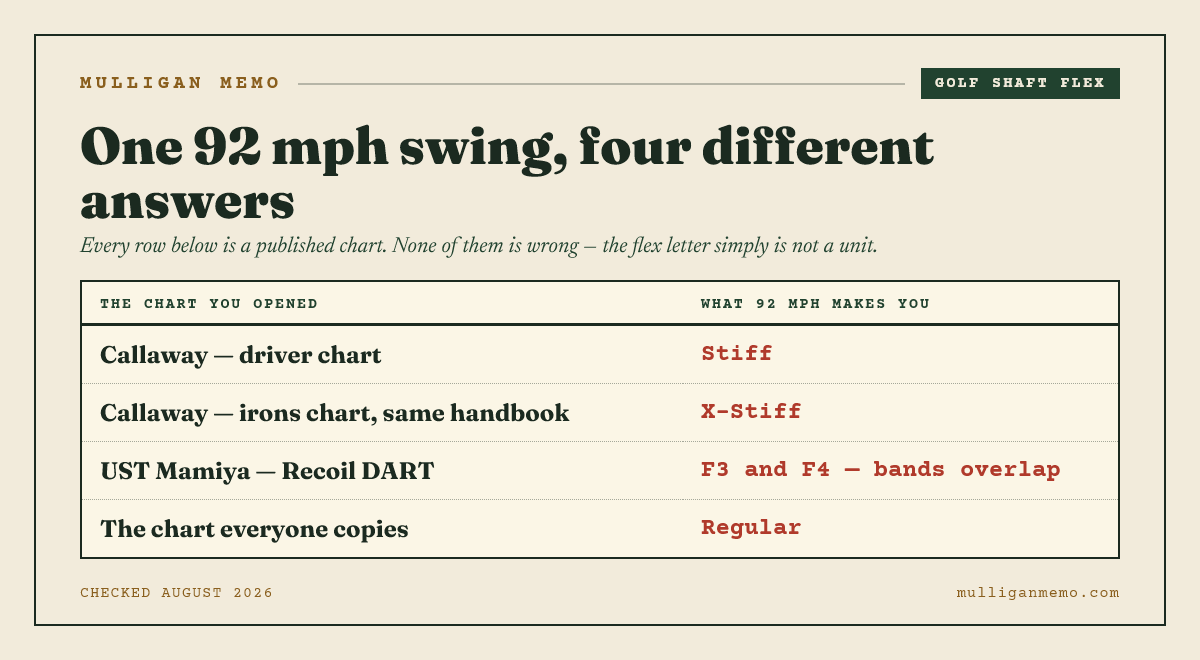
| Source | What 92 mph gets you |
|---|---|
| Callaway driver chart | Stiff |
| Callaway irons chart | X-Stiff |
| UST Mamiya Recoil DART | Both F3 and F4 — the bands overlap |
| The chart at the top of this page | Regular |
Nobody in that table is wrong. Callaway is describing Callaway's shafts, UST is describing UST's, and the aggregated chart is describing the average of a lot of fittings. The letter is each manufacturer's shorthand for its own product line. It was never a unit.
One more detail worth knowing: the widely circulated bands do not match any manufacturer chart we found. Callaway's break points are 70/80/90/105 and its chart has no Senior or A row at all. The familiar chart is its own thing, assembled from fitting experience — which is exactly what its publishers say it is.
And Callaway, the brand publishing the most explicit speed chart of any we found, prints the limit of it on the same page:
"Remember — this is a guide only — you will not know if a shaft works for someone until you test them with it."Callaway, OPTIFIT Custom Fitting Handbook (2024 EU/UK edition)
They add the reason, and it is the variable no chart contains: "Two players swinging at the same speed but each with a different tempo could have completely different shaft recommendations."
The testWhat happened when someone checked
Plugged In Golf ran the obvious experiment: six golfers, handicaps from 10 to scratch, seven shots each with regular, stiff and extra-stiff shafts in the same 6-iron head, measured on Trackman.
Two results matter here. The first is that the stiffer-is-more-accurate assumption did not hold — they found accuracy "is a matter of fit," with some players most accurate in regular, some in stiff and some in extra-stiff. The second is the one that speaks directly to the chart:
Two testers 20 mph apart both performed best with regular flex.
A swing-speed chart would have put those two golfers in different flexes with confidence. The launch monitor put them in the same one.
It is a small study — six golfers, one head model, one session — and it should be read as the best available test rather than proof. But it points the same direction as the frequency data and as the manufacturers' own language: the letter on the shaft is a category, not a measurement of you.
Worth noting too: fit still mattered enormously. Each tester had one flex that clearly outperformed the others, with gains up to 16 yards. The finding is not that flex is irrelevant. It is that you cannot derive it from a number.
Numbers on shaftsWhat 5.5 and 6.0 actually mean
Some shafts skip letters entirely and use numbers — Project X irons are sold as 5.0, 5.5, 6.0, 6.5 and so on. This confuses people because it looks like a finer-grained standard.
It is not a cross-brand standard either. It is an internal scale for one product line. Because flex is not standardised to begin with, a number no more corresponds to a fixed stiffness than a letter does — and the tidy conversion tables you will find online, mapping each number to a flex letter, are third-party constructions rather than anything printed on the shaft. Treat the numbers exactly like letters: useful for comparing two shafts within the same family, and not a translation table.
What to doUsing the chart properly
Know your actual swing speed first. The chart is worthless without a real number, and most golfers guess high. If you have never measured it, that is the single most valuable thing to fix — and it is what the cheapest launch monitors exist to tell you.
Use the chart to pick a starting category, not an answer. It narrows five options to about two. That is genuinely useful and it is all anyone claims for it.
Then hit both. If you are between Regular and Stiff, the only reliable way to resolve it is to hit the two shafts and look at the numbers. Every source in this guide — the chart's publisher, the components company, the shaft manufacturer, and the people who tested it — says some version of the same thing.
Do not carry a flex letter between brands. "I play stiff" is not portable information. If you are buying a different shaft model, you are starting over, and the frequency data is why.
The last wordThe chart isn't the problem
It is tempting to write this topic up as a debunk, and that would be wrong. The chart is a reasonable summary of aggregated fitting experience, and the outlet that publishes the best-known version is candid about exactly what it is.
The problem is downstream. A table travels well and a caveat does not, so the internet is full of the numbers without the sentence that makes them safe to use. If you take one thing from this page, take the sentence: shaft flex is not standardised, so the letter tells you a category and nothing more.
FAQCommon questions
What shaft flex do I need for my swing speed?
As a starting category, the commonly published bands are under 72 mph for Ladies, 72–83 for Senior, 84–96 for Regular, 97–104 for Stiff and 105+ for Extra Stiff, measured with a driver. But those bands come from aggregated fitting data rather than any manufacturer specification, and shaft flex is not standardised between brands. MyGolfSpy, who publish that chart, note you "might swing 100 mph and fit into a stiff in one shaft and an X-stiff in another." Use the chart to narrow the field, then confirm on a launch monitor.
Is golf shaft flex standardised between brands?
No. There is no industry standard for what Regular or Stiff means. The GolfWorks measured frequency across "27 different shaft manufacturers" and "well over 1100 shafts" and publish charts showing "the ranges for each flex and the overlap that can occur" — meaning a single shaft could legitimately be labelled two different flexes depending on who made it. The manufacturers' own charts show it too: Callaway's fitting handbook maps 80–90 mph to Regular on its driver chart and to Stiff on its irons chart, and UST Mamiya's published bands overlap so that 80–85 mph falls in two flexes at once. Flex also varies with club length, so the same shaft measures differently in a driver and an iron.
What does a 5.5 flex shaft mean?
It is a numbering system used in place of flex letters on some shaft lines, notably Project X. Because flex is not standardised to begin with, a number no more corresponds to a fixed stiffness than a letter does — and the conversion tables circulating online that map each number to a flex letter are third-party constructions rather than anything printed on the shaft. Compare numbers only against other shafts in the same family.
Does shaft flex actually matter?
Yes, but not in the way the charts imply. When Plugged In Golf tested six golfers across regular, stiff and extra-stiff on Trackman, each player had one flex that clearly outperformed the others, with gains up to 16 yards — so fit matters. What did not hold was the mapping to swing speed: two testers 20 mph apart both performed best in regular flex, and accuracy proved to be "a matter of fit" rather than a matter of stiffness. Flex matters; it just cannot be derived from a speed number.
Are stiffer shafts more accurate?
Not as a rule. Plugged In Golf specifically tested this and found the opposite of the common assumption: some players were most accurate with regular flex, others with stiff, others with extra-stiff. In their group the regular flex also produced slightly more club head speed, ball speed and smash factor on average. Accuracy tracked fit, not stiffness.
What is the best flex for senior golfers?
Senior (A) flex is the category the published charts assign to driver speeds around 72–83 mph, which is where many older golfers sit — but age is not the input, speed is, and speed varies widely among seniors. Because flex is not standardised, an A flex in one brand can play close to a Regular in another. Measure your driver speed, use it to pick a starting category, and compare two shafts rather than trusting the letter.