Golf Simulator Room Dimensions: What Each Launch Monitor Actually Requires
Search this question and you'll get seven different answers, from 12 feet deep to 30. Here's what the manufacturers themselves publish — quoted, linked, and with the gaps left visible.
Jump to a section
There is no single golf simulator room size, because the launch monitor decides it. A radar unit sits 6–8 feet behind the ball and needs roughly 15 feet of total room length. A camera unit sits 1–2 feet from the ball and needs almost no depth behind you. A ceiling-mounted unit needs a 9–10 foot ceiling window — and on some models a ceiling that is too high is a problem that costs extra to solve. Pick the launch monitor first, then measure for it.
The most expensive mistake in a home simulator build is not the launch monitor. It's buying the launch monitor after you've finished the room. Every unit in this guide publishes a different set of requirements, and two of them will disqualify a room that a third is perfectly happy in.
So the generic answer — the "10 feet wide by 15 feet deep by 9 feet high" that appears on page one of every search — is not wrong so much as unusable. It describes an average of products you have not chosen yet.
Start hereCheck your room against what's published
Enter the room you actually have. This checks it against the figures each manufacturer prints in their own documentation, and shows you the quote behind every verdict.
Enter your room above.
This checks the launch monitor only. A clear result means nothing the manufacturer publishes rules the unit out — not that it will fit. Two things it cannot check: your swing (SkyTrak puts a standard golfer at "at least a 9-foot ceiling and 10 feet of width" for a driver, and Garmin simply says "ensure you can take a full swing comfortably"), and any enclosure or screen, which carries its own footprint on top.
The one complete specOnly one maker publishes a whole room
Across every unit here, exactly one manufacturer states a full set of room dimensions in a single sentence. It's Garmin, for the Approach R10 — the cheapest popular launch monitor on the market:
"Your space must be at least 15 feet long by 8 feet wide by 8 feet high."Garmin, Tips for Indoor or Outdoor Approach R10 Placement
That eight-foot ceiling is worth sitting with, because it contradicts nearly everything else written on this subject. The retailer consensus is that nine feet is the floor and ten is comfortable. Garmin — the company that actually has to make the device work — publishes eight.
The two claims aren't really in conflict, though, and understanding why is the whole game. Garmin's eight feet is what the radar needs to see the ball. In the same article, under a separate heading, Garmin adds the part the number doesn't cover: "Ensure you can take a full swing comfortably in your hitting space." Those are two different questions. The device's requirement is a published fact. Whether a six-foot-two golfer can swing a driver under an eight-foot ceiling is a fact about the golfer.
Nearly every "minimum ceiling height" on the internet quietly merges the two and reports the result as a spec. That's why the numbers never agree.
The real variableDepth is decided by the technology, not the room
Launch monitors see the ball in one of three ways, and each way implies a completely different room.
Radar units sit on the floor behind you and track the ball in flight. They need real estate behind the ball before you even count the ball's flight to the screen. Garmin's R10 is placed "between 6 and 8 feet behind the ball," and the ball must sit "at least 8 feet away from the impact screen or net." Add those and the 15-foot room length stops looking arbitrary.
Camera units (the industry calls them photometric) sit beside or just past the ball and photograph it off the face. They need almost nothing behind you. Garmin's own camera-based R50 is placed "on the ground 1-2 feet in front of the ball" — and on the screen distance, Garmin is explicit that "there is not a set distance requirement," recommending "around 8 feet or more" for comfort rather than function.
That is the same brand, the same sport, and a difference of roughly seven feet of required floor. If your room is short, the technology you choose matters more than any other decision in the build.
Overhead units mount to the ceiling and look down. They ask for the least depth of all — and impose the one requirement nobody warns you about.
Why the numbers scatterThree different requirements, mashed into one
Here is the thing that explains every contradiction on this subject. A simulator room has to satisfy three separate requirements, and they are set by three different parties:
- The launch monitor needs to see the ball. That's the manufacturer's number, and as shown above it swings from eight feet of ceiling to a nine-to-ten-foot window depending on the technology.
- You need to swing a driver without hitting anything. That has nothing to do with the device and everything to do with your height.
- The enclosure, screen or net — if you buy one — has its own footprint, plus clearance to actually assemble it.
Almost every published "golf simulator room size" is one of those three presented as all three. SkyTrak is unusually clear about the distinction on their own space-planning page, and the example they give is the most useful single paragraph published on this topic:
"Even though this enclosure is only 7'6" tall and 8' wide, a standard golfer requires at least a 9-foot ceiling and 10 feet of width to safely swing a driver without hitting the walls or ceiling."SkyTrak, Plan Your Space
Read that carefully. The equipment is 7'6" tall. The golfer needs nine feet. Those are different numbers about different things, and the nine-foot figure — the one that has propagated across the entire internet as the launch monitor's requirement — is a swing-clearance figure.
That is also why the same brand can appear to contradict itself. SkyTrak declines to state a ceiling height for the ST MAX device, and separately publishes nine and ten foot guidance for golfers and studios. Both are true. They are answers to different questions.
SkyTrak's own studio minimums show how much the enclosure adds on top:
| SkyTrak studio | Enclosure footprint | Minimum room |
|---|---|---|
| Studio 8' | 8' W × 4' D × 7'6" H | 8.5' W / 15' D / 8' H |
| Studio 10' | 10' W × 5'4" D × 8'6" H | 11' W / 16' D / 9' H |
| Studio 12' | 12' W × 5'4" D × 8'6" H | 13' W / 16' D / 9' H |
| Studio 13' Deep | 13' W × 10' D × 10' H | 14' W / 17' D / 10'6" H |
Source: SkyTrak, Plan Your Space, checked August 2026. These are enclosure-package figures. None of them is a requirement of the SkyTrak launch monitor, which SkyTrak describes separately as sitting "next to the ball vs other launch monitors that require up to 8' behind the hitting area."
Full Swing works the same way: the company publishes no ceiling height for the bare KIT launch monitor, only for its KIT Studio bundles. If you have read a confident ceiling spec for a KIT, you have almost certainly read a bundle figure.
So when you see a number quoted without saying which of the three it is, treat it as unusable — because it is.
The trapFor ceiling-mounted units, higher is not better
Every guide on this topic treats ceiling height as a floor: clear the minimum and you're fine, and more is always better. For a ceiling-mounted launch monitor that is simply false. Uneekor's EYE XO2 manual states the requirement as a closed window:
"The mounting position of the EYE XO2 launch monitor device must be perfectly aligned 3 feet 6 inches in front of your tee position and between 9 - 10 feet for the ceiling height. Failure to meet these requirements will result in accuracy issues."Uneekor, EYE XO2 User Guide
And immediately after, the consequence of missing it in either direction: "If your ceiling height does not fall within these requirements, you will need a ceiling drop mount, to ensure your launch monitor is mounted within the 9-10 feet."
So an eleven-foot basement ceiling — the kind every buying guide would call ideal — puts an EYE XO2 outside its own stated window and adds hardware to the bill. TruGolf's APOGEE works the same way, recommending "9-10' H x 15' W" and directing buyers whose rooms fall outside that to talk to them first.
If you are shopping overhead, measure your ceiling and treat both ends of that range as real.
The honest oneThe most useful answer is a refusal
SkyTrak's ST MAX User Guide contains a table headed "Minimum Unobstructed Area Dimensions." Length reads 10 feet. Width reads 10 feet. The ceiling row does not contain a number at all. It reads "Varies," and the note explains why:
"Safe ceiling height varies and depends on your physical height and the length of your club."SkyTrak, ST MAX User Guide
That is the most accurate sentence written about simulator ceiling height by anyone, and it is the reason the published numbers scatter so badly. Ceiling height isn't a property of the launch monitor. It's a property of you holding a driver.
One footnote for anyone working in metric: SkyTrak's own guide prints both figures as "10 feet (3.35m)." Ten feet is 3.05 m. The conversion is wrong in the document, so work from the imperial figure.
The tableEvery figure, and every gap
Below is what each manufacturer publishes. Blank cells are not omissions on our part — they are things the maker does not state anywhere in the documentation linked at the end of each row. That matters, because most of the confidently specific numbers you'll find elsewhere are filling those blanks with someone's estimate.
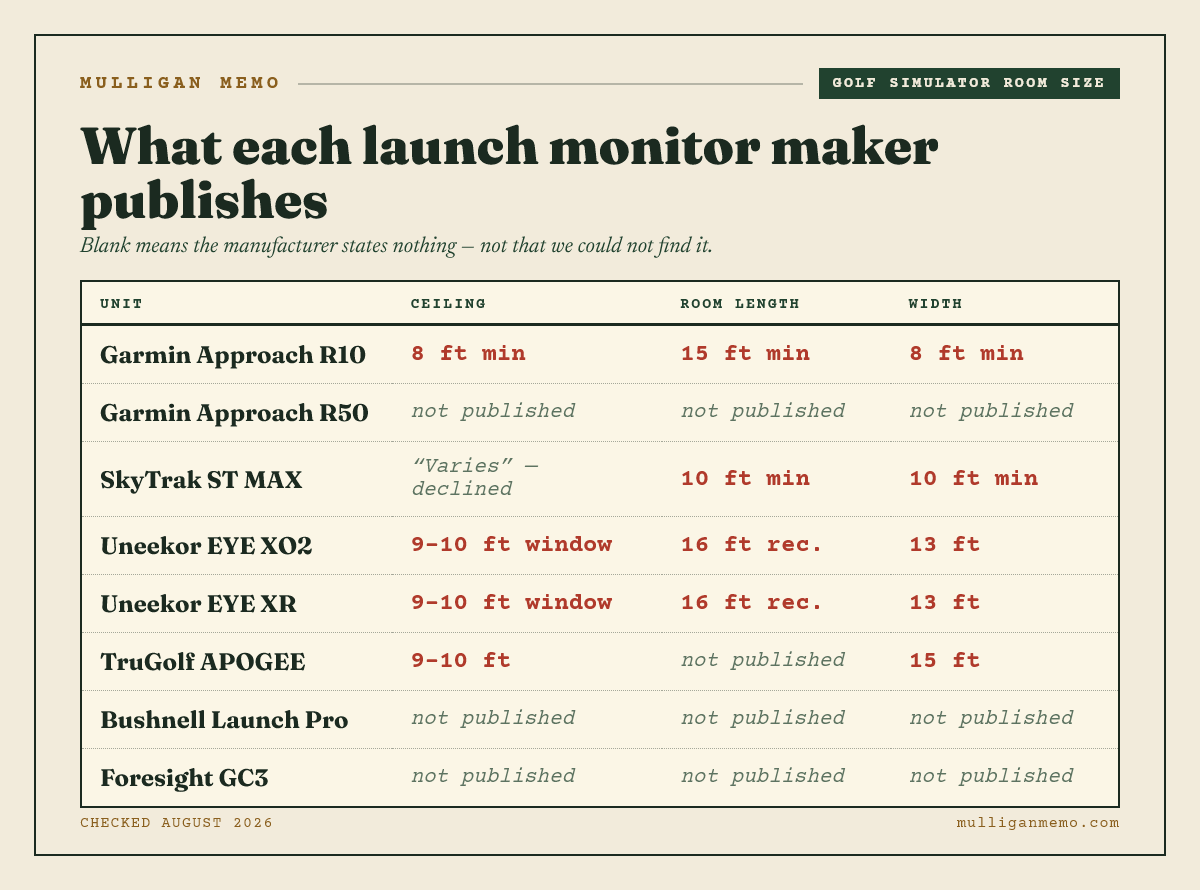
| Unit | Type | Ceiling | Room length | Width | Position |
|---|---|---|---|---|---|
| Garmin Approach R10 | Radar | 8 ft min | 15 ft min | 8 ft min | 6–8 ft behind ball; ball ≥8 ft from screen |
| Garmin Approach R50 | Camera | not published | not published | not published | 1–2 ft in front of ball; ~8 ft to screen suggested, no set requirement |
| SkyTrak ST MAX | Camera | "Varies" — declined | 10 ft min | 10 ft min | not published |
| Uneekor EYE XO2 | Overhead | 9–10 ft window | 16 ft recommended | 13 ft | Ceiling, 3 ft 6 in in front of the tee |
| Uneekor EYE XR | Overhead | 9–10 ft window | 16 ft recommended | 13 ft | Ceiling, 3 ft 6 in behind the tee |
| TruGolf APOGEE | Overhead | 9–10 ft | not published | 15 ft | Ceiling-mounted |
| Bushnell Launch Pro | Camera | not published | not published | not published | not published on the product page |
| Foresight GC3 | Camera | not published | not published | not published | not published on the product page |
Sources, in row order: Garmin R10 placement article · Garmin R50 setup article · SkyTrak ST MAX User Guide · Uneekor EYE XO2 User Guide · Uneekor EYE XR manual and product page · TruGolf APOGEE page · Bushnell Launch Pro page · Foresight GC3 page. Checked August 2026.
Two of those rows are worth pausing on. The EYE XO2 and EYE XR are siblings with the same 9–10 ft ceiling window, but the XO2 mounts 3 ft 6 in in front of the tee and the XR mounts 3 ft 6 in behind it. Same brand, same window, opposite direction — which is exactly why a figure lifted from one model and applied to its sibling is worthless.
And the two blank rows are not laziness. Bushnell and Foresight sell four-figure hardware and publish no room requirements on their product pages at all. Every confident number you have read for a GC3 or a Launch Pro came from somewhere other than the manufacturer.
WidthThe left-handed tax nobody mentions
Width gets treated as the easy dimension. It isn't, for one specific reason: a room that serves a right-handed golfer does not automatically serve a left-handed one, because the hitting position moves.
TruGolf's 15-foot width recommendation for the APOGEE is stated precisely this way — "For Right and Left Handed Players." It is a both-handed figure, not a general one. If a lefty and a righty will share the room, the width you need is not the width in most tables.
The Room Check above adjusts for this where the manufacturer publishes a dual-handed figure, and tells you when they don't.
Straight answersThe three questions people actually ask
Is a 12×12 room big enough? For a camera-based unit, possibly — SkyTrak's ST MAX asks for a 10 ft × 10 ft unobstructed area, and 12 × 12 clears it. For a radar unit, no: Garmin's R10 needs 15 feet of length and you are three feet short. This single question is the clearest illustration that the room doesn't decide — the device does.
Is an 8-foot ceiling enough? Garmin publishes 8 feet as the R10's minimum, so the radar will work. Whether your swing will is a separate question, and one every manufacturer either hands back to you or declines to answer. At 8 feet, expect to be honest about which clubs you can actually swing.
Is 9 feet enough? Yes, on both counts — and this is the one number with support from two directions. Nine feet satisfies every unit here that publishes a ceiling figure, and it is the bottom of the window for all three overhead units. It is also the figure SkyTrak publishes for the golfer rather than the gear: "a standard golfer requires at least a 9-foot ceiling and 10 feet of width to safely swing a driver." If you are building a room and want one number, nine feet of ceiling and ten of width is the defensible one. Taller players should still take practice swings before committing.
The last wordBuy the monitor, then measure
The order most people use is backwards. They pick a room, read a generic dimension table, conclude they need a bigger room, and stall. The order that works is to choose the launch monitor for your budget and your game, read what that specific manufacturer publishes, and measure against those numbers.
A 12-foot-deep garage rules out most radar. It rules out very little else. And a ceiling you were told was too low may be exactly what the cheapest unit on the market says it needs.
FAQCommon questions
What are the minimum golf simulator room dimensions?
There is no single minimum, because each launch monitor publishes its own. The only manufacturer here that states a complete room is Garmin, for the Approach R10: "Your space must be at least 15 feet long by 8 feet wide by 8 feet high." SkyTrak's ST MAX asks for a 10 ft by 10 ft unobstructed area and declines to state a ceiling height. Uneekor's EYE XO2 requires a 9–10 ft ceiling window. Choose the unit first, then measure against its figures.
Is a 12x12 room big enough for a golf simulator?
It depends entirely on the launch monitor. A 12 by 12 room clears SkyTrak's published 10 ft by 10 ft minimum unobstructed area for the ST MAX. It does not clear Garmin's published 15 ft minimum length for the radar-based Approach R10, which needs 6–8 ft behind the ball plus at least 8 ft from ball to screen. Camera-based units are the space-saver choice in short rooms.
Is an 8 ft ceiling enough for a golf simulator?
Garmin publishes 8 feet as the minimum ceiling height for the Approach R10, so the device itself is specified to work at that height. Swing clearance is a separate question that manufacturers hand back to the golfer — Garmin's advice is to "ensure you can take a full swing comfortably in your hitting space," and SkyTrak states outright that safe ceiling height "varies and depends on your physical height and the length of your club." At 8 feet, taller players should expect to be limited on driver.
Can a golf simulator ceiling be too high?
For ceiling-mounted units, yes. Uneekor's EYE XO2 manual specifies a closed window of 9–10 feet and states that outside it "you will need a ceiling drop mount." A ceiling above 10 feet therefore adds hardware and cost rather than being an advantage. Floor-standing radar and camera units have no published upper limit.
Why does every website give a different golf simulator room size?
Because a simulator room has to satisfy three separate requirements and most articles quote one of them as though it were all three. The launch monitor needs to see the ball, which varies by technology from an 8 ft ceiling to a closed 9–10 ft window. The golfer needs to swing a driver, which depends on height — SkyTrak puts it at "at least a 9-foot ceiling and 10 feet of width." And the enclosure or screen has its own footprint plus assembly clearance on top. A number quoted without saying which of the three it is cannot be used.
Does a golf simulator enclosure need more room than the launch monitor?
Usually yes, and it is a common source of confusion. SkyTrak's Studio 8' enclosure is 7 ft 6 in tall and 8 ft wide, but the minimum room they publish for it is 8.5 ft wide by 15 ft deep by 8 ft high, rising to 14 ft wide by 17 ft deep by 10 ft 6 in for the Studio 13' Deep. Full Swing likewise publishes ceiling heights only for its KIT Studio bundles, not for the bare KIT launch monitor. If a spec looks unusually demanding for a device that sits beside the ball, check whether it is actually a bundle figure.
Do radar launch monitors need more space than camera ones?
Considerably more, and in a specific direction — behind the ball. Garmin's radar-based R10 is placed 6 to 8 feet behind the ball, while Garmin's own camera-based R50 sits 1 to 2 feet in front of it. That difference is why the R10 carries a published 15-foot room length and camera units generally publish none. In a short room, the technology choice matters more than any other decision.